German and American cockroach eradication requires distinct physical protocols based on the target species' nesting biology. German cockroaches measure 0.5 to 0.6 inches, cycle through six nymphal instars in roughly 60…
German and American cockroach eradication requires distinct physical protocols based on the target species' nesting biology. German cockroaches measure 0.5 to 0.6 inches, cycle through six nymphal instars in roughly 60 days, and aggregate exclusively indoors near moisture and heat sources like refrigerator motor housings and dishwasher kickplates. American cockroaches average 1.5 to 2.1 inches, thrive in dark, humid environments such as sewer lines, sub-slab utility trenches, and wet crawl spaces, and routinely enter living zones through unsealed floor drains or foundation vents. If an infestation occurs inside kitchen cabinetry or motor housings, a precision food-grade gel bait matrix paired with a juvenile hormone analogue suppresses reproduction without airborne drift. If adult insects emerge from perimeter foliage or plumbing cleanouts, exterior microencapsulated barrier bands and mechanical sewer line exclusion deliver perimeter protection without interior chemical contamination.
Local housing density and coastal microclimates shape infestation dynamics across Los Angeles County. In older multi-family apartment corridors throughout Rose Park, Alamitos Beach, and Belmont Shore, shared wall cavities allow German roaches to migrate between units via plumbing stubs beneath sinks. In these environments, applying insect growth regulator concentrates alongside targeted gel baiting prevents nymphs from reaching reproductive maturity, containing the population without invasive broad-spectrum fogging. Meanwhile, American cockroaches, often referred to locally as waterbugs, regularly migrate out of municipal storm conduits in high-moisture neighborhoods near the water, such as Naples and the low-elevation foundations of Wrigley and California Heights. Ground-level moisture control and perimeter foundation barriers keep these large outdoor roaches from finding paths into living areas during warm seasonal surges.
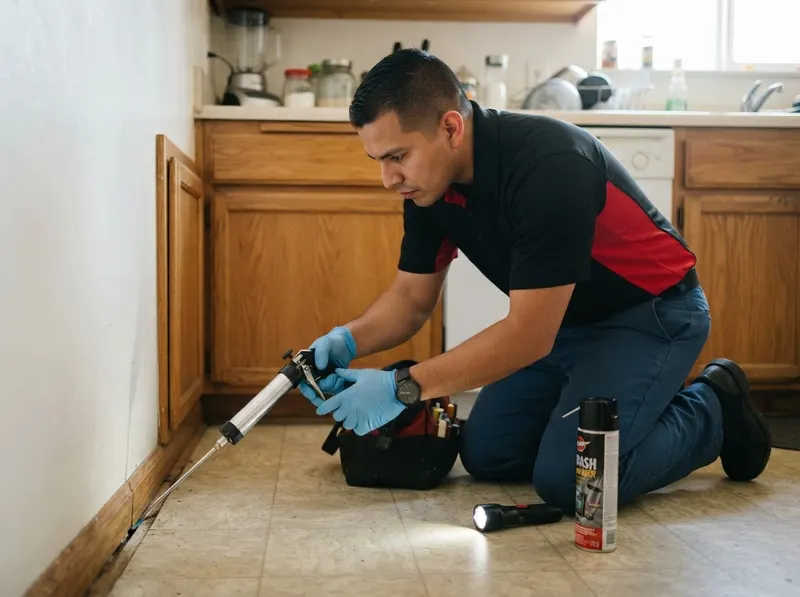
Execution follows an objective, sequential protocol: 1. Technicians visually inspect appliance motor bays, undersink plumbing wall penetrations, and subfloor access points with high-output inspection lamps. 2. Low-toxicity, non-repellent gel baits containing active ingredients such as indoxacarb or dinotefuran are placed in unexposed hinge voids, cabinet corners, and mechanical chases where aggregating roaches travel. 3. Desiccant dusts are injected directly into sealed plumbing voids behind drywall to dry out hidden harborage zones. 4. Exterior foundation perimeters receive a low-odor microencapsulated band extending three feet up the exterior wall and five feet outward to intercept incoming American cockroaches from gardens and city infrastructure. 5. Property owners receive specific moisture-abatement and sanitation guidelines, followed by a scheduled 14-to-21-day follow-up inspection to confirm interruption of the secondary hatch cycle.
Every job gets a firm, written price after a free on-site visit.
Tell us about your german and american cockroach eradication job in Long Beach and we'll send a clear, written quote, usually the same day.
 Crossroad Pest Control